Night image depends on the illuminator, not on the sensor count · review
Reolink RLC-510WA-B review
A fixed 5 MP bullet camera rather than a pan-and-tilt, and the only camera in this hub that will record to an FTP server or a Reolink NVR as well as to a card. Reolink states dual-band Wi-Fi, person, vehicle and animal detection, and 30 m night vision.
The bottom line The camera for someone who already knows what they want to watch. Fixed, higher resolution than the rest of this hub, and the only one that will write to your own server.
Everything else in this hub swivels. The RLC-510WA does not, and that is the
argument for it: a fixed camera is aimed once, at installation, and is
pointed there for the rest of its life. A motorised head covers more ground
and is also a mechanism outdoors, and it is only ever looking at one part of
what it can reach.
What it records to
This is the feature that separates it. Reolink states three destinations: a
microSD card of up to 512 GB, a Reolink NVR, or an FTP server. The last one
is the interesting one — it writes to a machine you own, which is the only
arrangement in this hub where taking the camera does not take the footage
with it.
A card in the camera is convenient and is also the first thing removed. An
FTP target on a NAS indoors is not.
Resolution and what it buys
At 5 MP this is the sharpest camera in the hub, and on a fixed lens that
resolution is spent on a single scene rather than spread across a sweep. For
a gate or a driveway entrance, that is the arrangement that produces a usable
image of a number plate or a face.
Night vision is infrared, stated to 30 m, and monochrome. Reolink does not
claim colour at night on this model.
A discrepancy worth noting
The product title cites IP67 while the manufacturer’s own feature list says
IP66. Both describe a housing that copes with weather; IP67 additionally
covers temporary immersion, which no wall-mounted camera experiences. Where a
maker’s own figures disagree, we quote the lower one.
Who it suits
Someone with a specific thing to watch and somewhere to write the recording.
It is not the camera for surveying a whole garden, and it is the best one
here for a fixed approach.
Availability
On sale from 70 € to 70 € on the German Amazon store at the time of checking.
Prices and availability are what Keepa reported on the date this page was updated; both move.
Prices quoted in this text were read on 2 September 2026. The live price is at the top of the page.
What we like, and what we don't
Strengths
5 MP — the highest resolution in this hub, stated by Reolink
Dual-band Wi-Fi: 2.4 GHz for reach, 5 GHz for a less congested channel
Records to microSD, to a Reolink NVR or to an FTP server of your own
Person, vehicle and animal classification filters the notifications
Compromises
Fixed, not pan-and-tilt — what it sees is decided at installation
Reolink states IP66 on this listing while the title cites IP67; treat the lower figure as the safe one
microSD card is not supplied
Mains powered, and the Wi-Fi model still needs its own adapter
Specifications
Resolution
5 MP, stated by Reolink
Field of view
Fixed lens — no pan or tilt
Night vision
Infrared, stated to 30 m
Wi-Fi
Dual band, 2.4 GHz and 5 GHz
Storage
microSD to 512 GB (not supplied), Reolink NVR, or FTP
Detection
Person, vehicle and animal classification
Weather rating
IP66 in the manufacturer's feature list
Amazon reference
B0BL3GKWCY (identical on 1 market)
Questions people actually ask
Why choose a fixed camera over a pan-and-tilt?
Because a fixed camera is always pointed where you put it. A pan-and-tilt covers more ground but is only ever aimed at one part of it, and a motorised head is a moving part in the weather. For a gate, a door or a driveway entrance, fixed is the more reliable choice.
What is the FTP option for?
It writes recordings to a server you control — a NAS, or a computer that is always on — rather than to the card in the camera or to a cloud plan. It is the only way in this hub to keep footage somewhere a thief cannot take with the camera.
Is 5 GHz better?
Not always. Reolink states the camera supports both and explains the trade: 2.4 GHz reaches further through walls, 5 GHz is less congested. Outdoors at distance, 2.4 GHz is usually the right choice despite being the busier band.
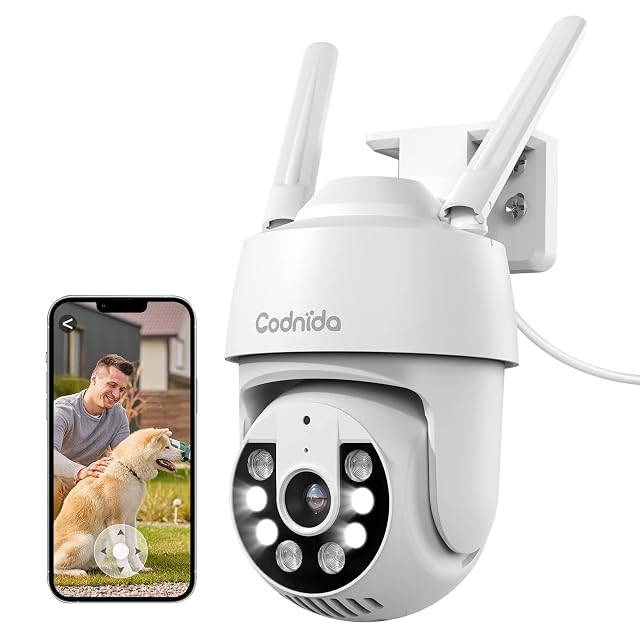
2K 3MP · 350° pan, 90° tilt · colour night vision · siren · 2.4 GHz only
A 2K pan-and-tilt outdoor camera with a floodlight and a siren that trigger together on motion. Codnida states auto-tracking, a PIR sensor and custom detection zones, and the camera runs on mains power rather than a battery.
Best for: A driveway or side passage where the point is to make an approach visible and audible, not just recorded.
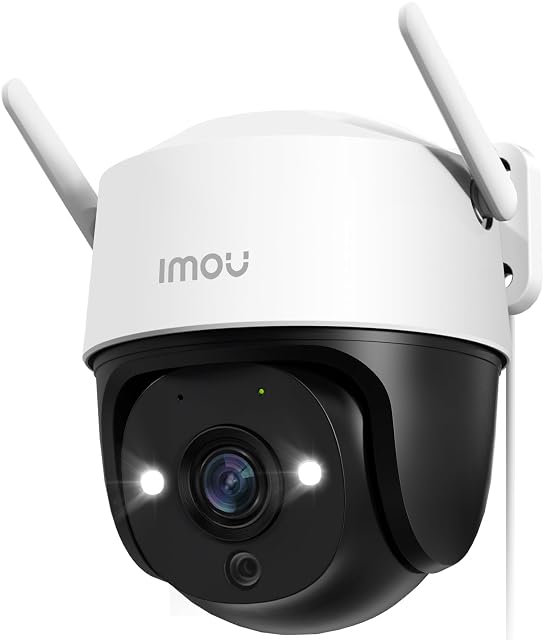
2K 3MP · 355° pan, 90° tilt · full-colour night vision · 110 dB siren · IP66
Imou states a 3 MP sensor, four night-vision modes including full colour, AI person and vehicle detection and a 110 dB siren, in a dual-antenna housing rated IP66. It sits between the budget cameras and the tracking models in price and in capability.
Best for: A garden or driveway where false alarms from foliage and insects have already made a cheaper camera unusable.
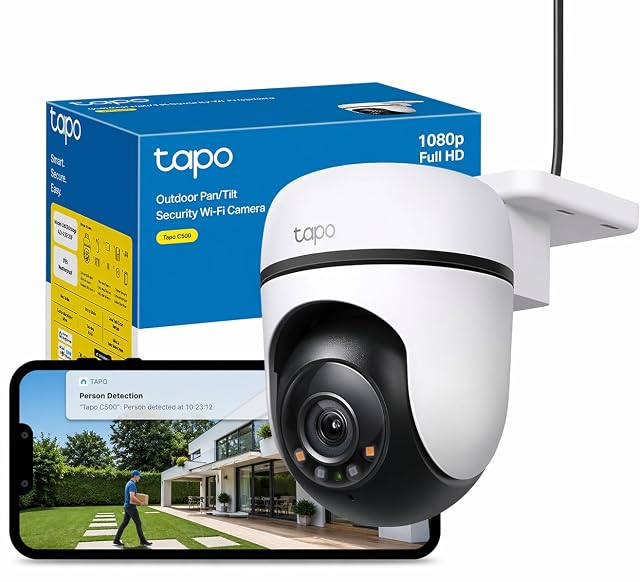
1080p · 360° pan, 130° tilt · 30 m IR · microSD to 512 GB · IP65
The cheapest way into a pan-and-tilt outdoor camera that records to its own card. TP-Link states 1080p, a 360° horizontal sweep and night vision to 30 m, and the listing is unusually frank about what the model is not.
Best for: A first outdoor camera on a wall that already has a socket nearby, where 1080p is enough and the card matters more than the picture.