Night image depends on the illuminator, not on the sensor count · review
Codnida YM-COD-Q30S-E review
A 2K pan-and-tilt outdoor camera with a floodlight and a siren that trigger together on motion. Codnida states auto-tracking, a PIR sensor and custom detection zones, and the camera runs on mains power rather than a battery.
The bottom line A lot of hardware for the money, held back by 2.4 GHz-only Wi-Fi and by a brand with little track record. The light and siren are the reason to choose it.
This is the cheapest way to get a floodlight, a siren and a 2K pan-and-tilt
head on one bracket. Codnida states that the light and the siren both trigger
automatically when motion is detected at night, which is the behaviour that
separates a camera somebody notices from a camera that quietly records.
What it actually does
The head sweeps 350° horizontally and 90° vertically, and the camera can
follow a moving subject automatically. Detection is by PIR — a passive
infrared sensor that reacts to moving warmth rather than to changing pixels —
with user-defined zones, which is the setting that decides whether the camera
reports a person or a passing bus.
Colour at night depends on the floodlight. With it off, four infrared LEDs
give the usual monochrome image; with it on, the sensor produces colour and
the camera announces itself, which is the trade this category always asks you
to make.
The specification that will catch you out
Codnida states 2.4 GHz Wi-Fi only, and says explicitly that 5 GHz is not
supported. On a router that publishes both bands under a single network name,
setup fails in a way that looks like a fault: the phone is on 5 GHz, the
camera cannot join it, and nothing explains why. Separating the bands, or
temporarily disabling 5 GHz, is the fix.
Who it suits
A driveway, a side passage or a rear yard where the object is to light an
approach and make it audible. It is not the camera for identifying a face at
distance, and the auto-tracking needs a home position set before it is
useful.
Availability
On sale from 30 € to 36 € on the German, French, Italian and Spanish Amazon stores at the time of checking.
Listed but with no offer on the American and British Amazon stores — the reference exists there and nobody is currently selling it.
Prices and availability are what Keepa reported on the date this page was updated; both move.
Prices quoted in this text were read on 2 September 2026. The live price is at the top of the page.
What we like, and what we don't
Strengths
Floodlight and siren activate together on night-time motion, per the manufacturer
2K (3 MP) sensor with colour night vision when the light is on
PIR motion sensor with custom detection zones, which cuts false triggers
Plug-in mains power, so there is nothing to recharge
Compromises
2.4 GHz Wi-Fi only — the manufacturer states 5 GHz is not supported
Auto-tracking means the camera can be pointed away from the entry it was bought for
A siren on a boundary is a neighbour problem before it is a deterrent
Brand support and firmware history are thin compared with the established names
Specifications
Resolution
2K, 3 MP, stated by Codnida
Coverage
350° horizontal, 90° vertical
Night vision
Four infrared LEDs, plus colour with the floodlight on
Detection
PIR sensor with user-defined zones
Wi-Fi
2.4 GHz only — 5 GHz not supported
Power
Mains adapter, continuous recording supported
Amazon reference
B0BPH1L3N4 (same reference on 6 Amazon marketplaces)
EAN
0638457758696
Questions people actually ask
Will it connect to a 5 GHz network?
No. Codnida states 2.4 GHz only. On a modern router that broadcasts both bands under one name, this is the single most common reason a camera of this type will not complete setup — the phone joins 5 GHz and the camera cannot follow.
Does the siren help?
It makes an approach unpleasant and it wakes a household. It does not stop anyone, and on a boundary with a neighbour it will be heard by them far more often than by an intruder. Set the detection zone to your own ground before enabling it.
Is auto-tracking worth having?
It is useful for following someone across a yard and a liability if the camera is your only one, because a camera that has swung to follow a cat has its back to the gate. Set a home position it returns to, pointed at your weakest entry.
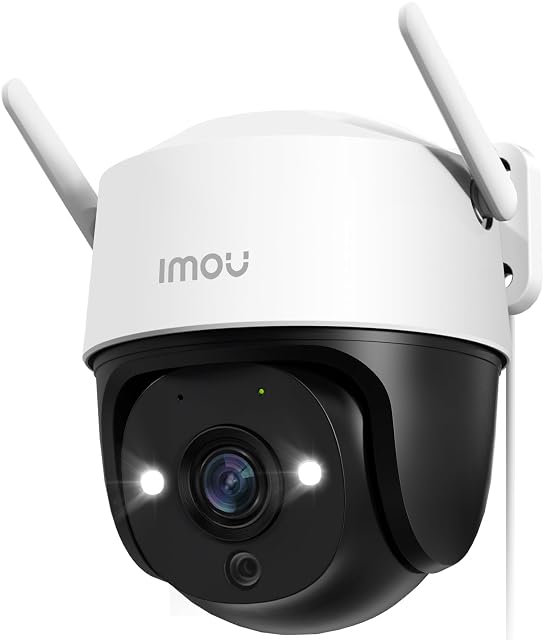
2K 3MP · 355° pan, 90° tilt · full-colour night vision · 110 dB siren · IP66
Imou states a 3 MP sensor, four night-vision modes including full colour, AI person and vehicle detection and a 110 dB siren, in a dual-antenna housing rated IP66. It sits between the budget cameras and the tracking models in price and in capability.
Best for: A garden or driveway where false alarms from foliage and insects have already made a cheaper camera unusable.
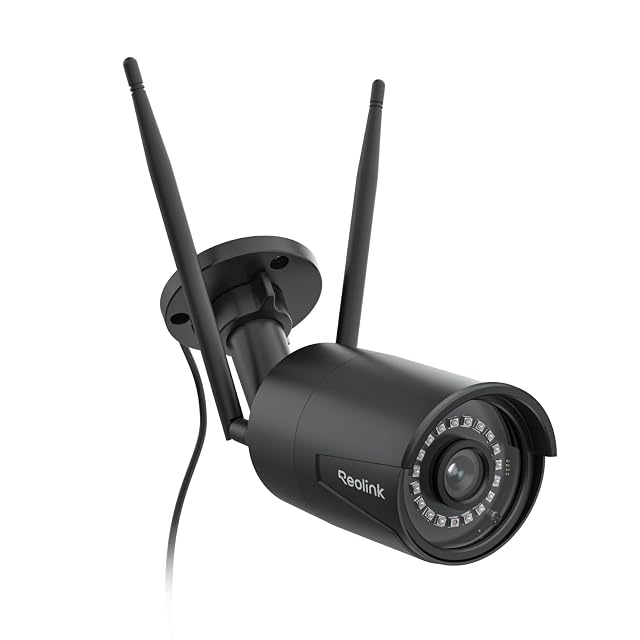
5MP · dual-band 2.4/5 GHz · 30 m IR · microSD to 512 GB, NVR or FTP · IP66
A fixed 5 MP bullet camera rather than a pan-and-tilt, and the only camera in this hub that will record to an FTP server or a Reolink NVR as well as to a card. Reolink states dual-band Wi-Fi, person, vehicle and animal detection, and 30 m night vision.
Best for: Someone who wants a fixed camera pointed at one thing permanently, recorded somewhere other than the camera itself.
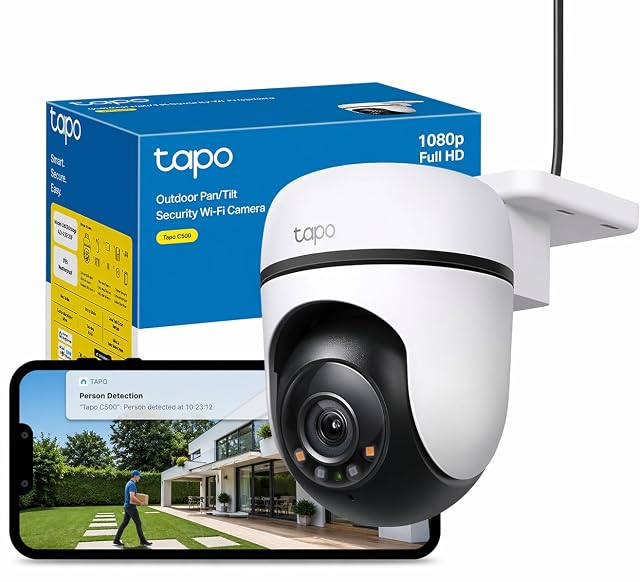
1080p · 360° pan, 130° tilt · 30 m IR · microSD to 512 GB · IP65
The cheapest way into a pan-and-tilt outdoor camera that records to its own card. TP-Link states 1080p, a 360° horizontal sweep and night vision to 30 m, and the listing is unusually frank about what the model is not.
Best for: A first outdoor camera on a wall that already has a socket nearby, where 1080p is enough and the card matters more than the picture.