Skip to content

False alarms: four fixes, three of them free

A system that notifies too often is a system that gets muted, and a muted system is no system. Most false alarms are placement rather than product: a sensor facing a radiator, a camera watching a pavement, a detection zone drawn around a garden instead of across a gate.

The four causes, and what actually fixes each.

Heat that is not a person

Radiators warming up, sunlight tracking across a floor, a cat on a windowsill. PIR sensors see moving warmth. Move the sensor off walls carrying radiators and away from windows facing direct sun — no setting fixes this.

Movement that is not an intruder

Branches, insects, rain. AI person and vehicle classification handles the first, and nothing handles an insect on the lens except mounting out of the weather.

The wrong area

A zone drawn around a whole garden reports the pavement. Draw it tightly, or use a crossing line at the gate.

The wrong direction

PIR sensors detect movement across their field far better than towards it. Mount beside the approach looking across, never at the end looking down.

And a snapshot

A camera that photographs what triggered it answers the question rather than raising it.

What we recommend, and why

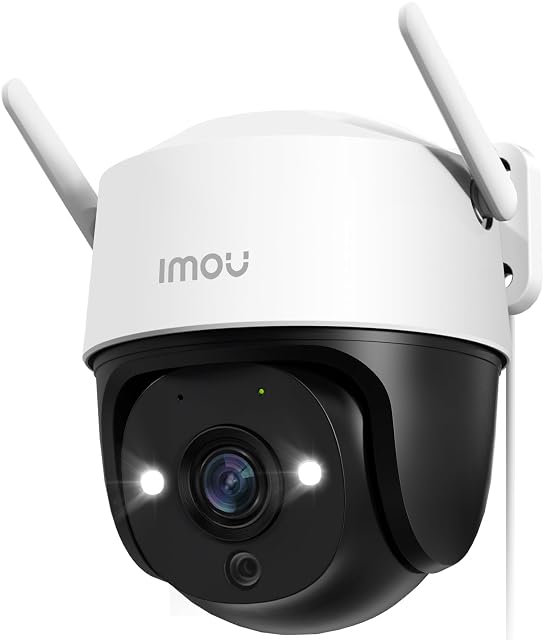
  1. Imou S21FEP

    2K 3MP · 355° pan, 90° tilt · full-colour night vision · 110 dB siren · IP66

    Imou states a 3 MP sensor, four night-vision modes including full colour, AI person and vehicle detection and a 110 dB siren, in a dual-antenna housing rated IP66. It sits between the budget cameras and the tracking models in price and in capability.

    Best for: A garden or driveway where false alarms from foliage and insects have already made a cheaper camera unusable.

    ≈ 34 €

Questions people actually ask

What causes most false alarms outdoors?

Moving foliage, headlights sweeping a wall, and insects on the lens at night lit by the camera's own infrared. AI classification handles the first two well and cannot help with the third, which is a placement problem — mount under an eave.

What is line-crossing detection?

A virtual line the camera reports things crossing, in a stated direction. It is far more precise than a zone: somebody walking along the pavement past your gate triggers a zone every time and crosses a line never.

The tool we use ourselves

Chosen your tool? Now buy it at the right price.

Cameras, alarm kits and safes swing by thirty euros or more across the year, and the biggest "discounts" often land at prices the same model sold for six weeks earlier. UniverTrack tracks the real price history across retailers, spots fake reductions, and alerts you when it is genuinely the moment to buy.

Real price historyBuy-now alertsAI buying assistant
Try free for 14 days →
No commitment · Cancel in one click · 5 languages